World-class security
Eliminate single points of failure with a state-of-the-art multisig wallet. Extensive hardware support, decoy wallets, advanced coin control and emergency lockdown.
The first Bitcoin inheritance solution designed to outlive the company that created it. Built on the most advanced multisig platform.
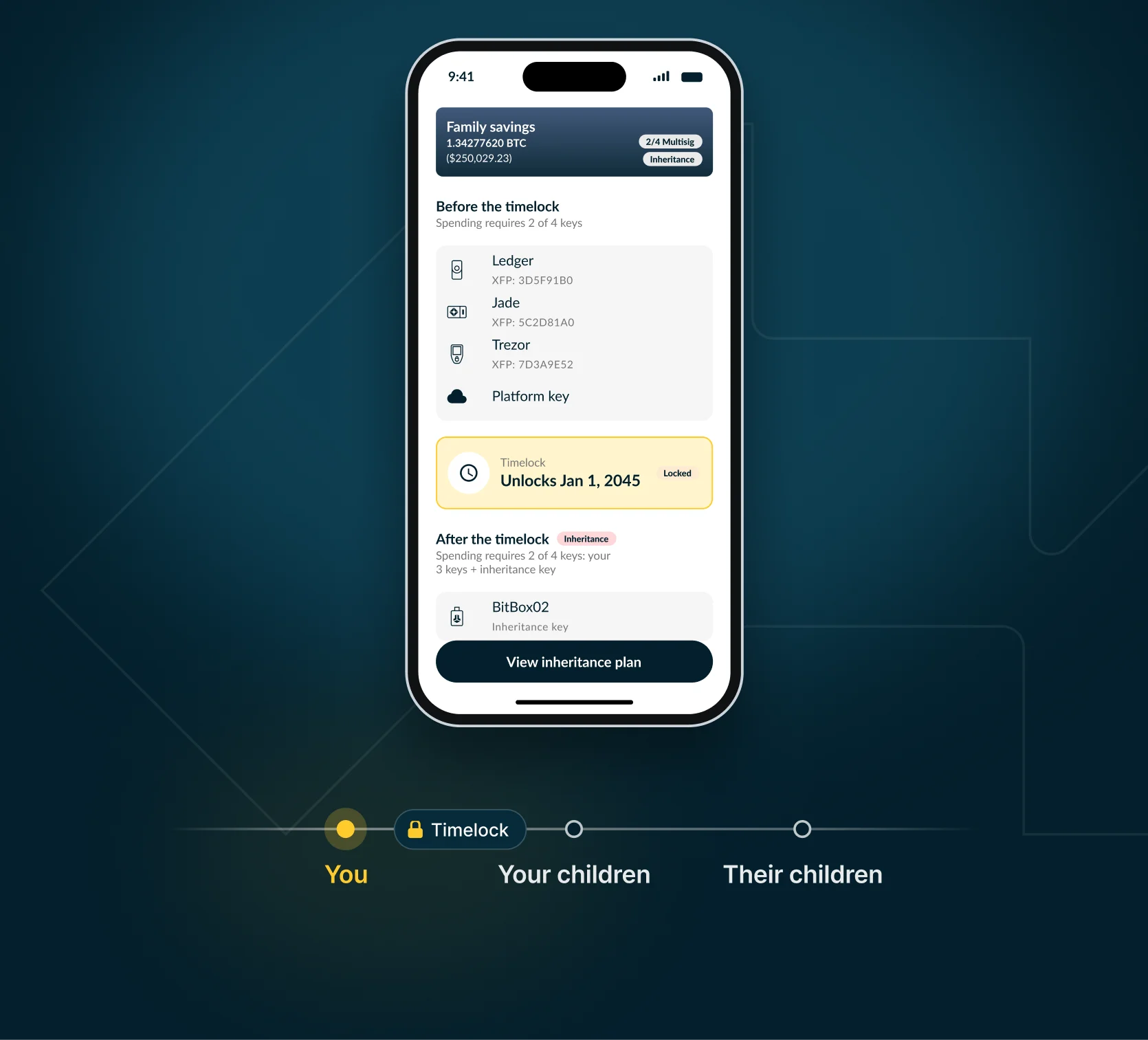


Eliminate single points of failure with a state-of-the-art multisig wallet. Extensive hardware support, decoy wallets, advanced coin control and emergency lockdown.
Autonomous inheritance with on-chain timelocks, designed to outlive us. The most comprehensive non-KYC inheritance solution available.
Security shouldn't cost you your privacy. We minimize data collection and protect you and your family at every step.
Secure your legacy with the most advanced non-KYC inheritance service. On-chain timelocks let your heirs claim your bitcoin on their own, even if Nunchuk no longer exists. Guided assistance is available when they need it.

| Feature | NunchukRecommended | Exchanges/ Custodians | Hardware wallets | Other multisig services |
|---|---|---|---|---|
| Autonomous inheritance (on-chain execution) | Yes | —No | —No | —No |
| Guided inheritance assistance | Yes | —No | —No | ✓Yes |
| Strictly no KYC | Yes | —No | ✓Yes | —No |
| No single-point-of-failure | Yes | —No | —No | ✓Yes |
| Multi-user collaborative custody | Yes | —No | —No | —No |
| Minimal dependencies | Yes | —No | Sometimes | —No |
| Built on open standards | Yes | —No | Sometimes | Sometimes |
Enjoy the world's first NFC-capable Bitcoin cold storage. Set up your wallet and sign transactions with simple taps on your phone. No wires required.
Restore your wallet configuration on a new device in a few simple steps with assisted recovery. Your private keys always stay under your control.

Self-custody multisig, assisted multisig or the world's first multi-user collaborative multisig. Manage bitcoin yourself, with your family or with your business partners, all in one wallet.


Looking for an air-gapped setup? Sign your transactions with QR codes or over SD cards. Combine air-gapped and NFC keys for the best of both worlds.

Co-manage bitcoin with your family or business partners. Communicate and transact securely and privately, all in one place.
Mix keys from different makers in one multisig wallet, so no single vendor can put your bitcoin at risk. How multi-vendor multisig works →


Want to help your clients secure their bitcoin through collaborative custody? We've got you covered.
Explore Byzantine
The Sovereignty Paradox Bitcoin introduced the world to true digital sovereignty. For the first time, individuals can hold wealth securely without relying on banks, governments, or custodians. This power is encapsulated in the phrase: “Not your keys, not your coins.” However, this profound responsibility creates a unique challenge when planning for the future: The Sovereignty Paradox. How do you ensure your Bitcoin is securely transferred to your heirs after you are gone, without compromising your security today or reintroducing the trusted third parties Bitcoin was designed to eliminate? If you simply give your heirs a copy of your keys now, you increase the risk of theft during your lifetime. If you hide your keys too well, your heirs may never find them. And if you rely on a company to manage the transfer, what happens if that company fails or is compelled to freeze your assets? The stakes are high. Blockchain analysis firms estimate that several million Bitcoin have been lost forever — inaccessible because the private keys are gone due to misplaced hardware, forgotten passwords, or the death of the owner. While it’s impossible to know exactly how many of these losses are due to failed inheritance plans, the absence of a proper succession strategy is a significant, preventable risk that threatens the generational wealth of Bitcoin holders. This guide provides a comprehensive framework for navigating this challenge. We will explore the landscape of Bitcoin inheritance solutions, evaluate their trade-offs, and introduce the emerging standard for securing your Bitcoin for generations.
02Today, we are proud to announce a major evolution of our platform and the realization of our core mission: Nunchuk 2.0. This launch introduces the first assisted inheritance solution designed to outlive the company that created it. For years, Bitcoin inheritance has presented a difficult trade-off: the convenience of assisted, collaborative custody solutions required trusting the provider’s long-term survival, while autonomous, self-sovereign solutions demanded significant technical expertise from both the user and their heirs. Nunchuk 2.0 eliminates this compromise. By leveraging the power of Miniscript and on-chain timelocks, we now offer an inheritance solution that combines the ease of guided assistance with the absolute guarantee of autonomous execution — enforced by the Bitcoin network itself. A Mission Forged Under Pressure As detailed in our mission statement, [“Our North Star,”](Link to Article 1) the Freedom Convoy crisis in 2022 forged our DNA and clarified our mission: to build tools that maximize individual financial freedom and privacy. That event taught us that true sovereignty requires technologies designed to withstand pressure — not just from governments, but from time itself. Nunchuk 2.0 is the direct continuation of that commitment. The Breakthrough: Autonomy Meets Assistance Our new On-chain (Autonomous) protocol offers a unique dual-path recovery model, ensuring access for your heirs under any circumstances. 1. The Smooth Path (Guided Claim): We provide comprehensive, guided assistance to your beneficiary. Our automated service leads them through the entire process, reducing complexity and anxiety during a difficult time. Human experts are on standby, in case they run into any issue. This service is included with an active subscription. 2. The Failsafe (Autonomous Self-Claim): Upon creation of the plan, you receive a comprehensive digital package (PDF) with full instructions for your beneficiary to independently recover the funds using open-source tools. This ensures your legacy is protected even if Nunchuk is unavailable. This dual-path approach — combining an assisted service with an autonomous guarantee — is the first of its kind in the industry.
03Nunchuk's off-chain timelock inheritance now works with Ledger, Trezor, Keystone, Jade and more, and your heir can claim it without being technical. See how the key reaches them and how the timelock keeps it safe.
On the fateful day of February 17, 2022, we received a Mareva injunction from the Ontario Superior Court of Justice, ordering us to freeze and disclose information about the assets involved in the Freedom Convoy protest. Little did we know that this event would change the trajectory of our small startup and forge the DNA that is now deeply ingrained in Nunchuk. It was a shocking and difficult moment. The mood within the team was solemn. Most of us had never been near a courtroom, yet we could sense the gravity of the situation. Nunchuk, at this point a startup still in its infancy, had somehow become entangled in one of the most controversial conflicts of the Covid era. The Freedom Convoy protest erupted mainly because of the mounting frustration of the working class over two years of social distancing, lockdowns, and vaccine mandates. Many were deprived of their livelihood and any sense of normalcy. People had had enough. Something had to give. The Freedom Convoy protest lit a fire in the Western world and quickly inspired similar movements globally. We became involved because a few days earlier, several Bitcoiners had helped protesters set up a Nunchuk wallet to receive Bitcoin donations. Nunchuk is a self-custodial Bitcoin wallet, meaning that we had no ability to comply with the court’s ridiculous order. Nor was Nunchuk a Canadian company. Yet, the threat seemed very serious, and there was no telling how far the Canadian government was willing to go. A week prior, Justin Trudeau had — for the first time in Canadian history — invoked the Emergencies Act. Designed to be used during wars or against terrorists, the government began wielding its tremendous power against the protesters. Protesters’ bank accounts were frozen without due process — actions later deemed unreasonable and unjustified by a federal court. The Royal Canadian Mounted Police (RCMP) demanded that regulated financial firms blacklist Bitcoin addresses allegedly connected to the Freedom Convoy. The Ontario Securities Commission flagged tweets by Coinbase CEO Brian Armstrong and Kraken CEO Jesse Powell criticizing the use of the Emergencies Act to law enforcement. Balaji Srinivasan questioned whether Canada was still a “democracy”. Sites like GoFundMe seized, then returned, millions of dollars worth of donations at the request of the Canadian government. Police began mobilizing in Canada’s capital. It seemed the authorities were willing to use everything at their disposal, even illegal means, to quash the protest. Many Bitcoin companies, US companies included, wanted nothing to do with the protest despite having tens of millions in VC funding, fearing the wrath of the Canadian government. Jesse Powell, having previously donated one bitcoin to the protest, warned users that Kraken “cannot protect you” from the Canadian government. Elon Musk, who voiced support for the protesters, tweeted “I wish I could help. At this point, it seems that voting at the next election is the remedy.” The most powerful CEOs in the world seemed powerless in the situation. Friends and lawyers I talked to also gave conflicting advice. Who, in their right mind, would want to say no to one of the biggest governments in the world, who just showed that it’s willing to throw around its full weight? Do you even have the resources to fight if it becomes a drawn-out legal battle? They could litigate us to death. Everyone was on edge. So much uncertainty was in the air. I told the team about the court order. Concerned about the increased risks they might bring to their families, two members of our team decided to quit shortly after. I told them I understood and wished them luck. The rest of the team stayed. I thought about the possibility of having to shut down Nunchuk, if push came to shove. To complicate the situation, my own personal life was also in great upheaval. Around the time Justin Trudeau invoked the Emergencies Act, I learned that I would soon become a father. I went from pure joy to total distress within a week. I thought about the world my child was going to grow up in. Then I thought about why I got excited about Bitcoin and decided to start a Bitcoin company in the first place. If Bitcoin couldn’t matter in a situation where people needed it most, what good is it? Is there any value in building a Bitcoin company at all? How will it be any different from the corrupt and permissioned financial system we grew up with? The one that brought the world to its knees in the Great Financial Crisis, along with many other social woes that we’ve only begun to understand since the shift in 1971? What’s the point of it all? What will I tell my son, when he grows up, about what happened in February 2022? Then I sat down and wrote a reply to the Ontario Superior Court of Justice. [Nunchuk's response to the Ontario Superior Court of Justice, February 2022.] The Path to Autonomy That email became our North Star. It clarified our mission: to build tools that maximize individual financial freedom and privacy, minimizing reliance on any third party. Our commitment to advanced multisig architecture and open standards ensures that we can never unilaterally access user funds — a principle forged under pressure. This event taught us that true sovereignty requires technologies designed to withstand pressure. Not just from governments, but from time itself. If we are to secure wealth for generations, our solutions must eliminate all single points of failure. This commitment is why we have dedicated ourselves to building the most trust-minimized solutions possible. Our new on-chain timelock inheritance protocol, enabled by the innovation of Miniscript, is the direct continuation of the journey that began in February 2022. It is the first assisted inheritance solution designed to outlive the company that created it — guaranteed by the Bitcoin network, not by us. We are building Nunchuk to help secure the world we want our children to inherit. A world that respects individual freedom and privacy.
05A single transfer isn't always the right plan. When you set up a Bitcoin inheritance, the default assumption is that everything moves to one person, all at once, the moment the plan triggers. For many people, that's exactly what they want. But not for everyone. Maybe you're splitting your estate between a spouse and two kids. Maybe one heir is ready for a lump sum and another isn't: a 19-year-old inheriting a large amount overnight is a different situation than a 19-year-old receiving a set amount each year. Maybe you just want to stagger distributions for tax or planning reasons. Until now, a Nunchuk inheritance plan released everything at a single moment: one beneficiary, one unlock. Phased Rollout opens that up: you can split the inheritance across several people, and release each share gradually over time instead of all at once. What Phased Rollout does Phased Rollout adds two capabilities to the off-chain inheritance protocol: Split across beneficiaries. Divide the inheritance between multiple people, each with their own share. Your spouse gets 60%, your son gets 40%, or whatever split fits your family. Distribute over time. Instead of a single release, you can break each beneficiary's share into stages. A stage is a portion of the inheritance that becomes available at a scheduled time. One beneficiary might receive everything in Year 5. Another might receive 2% per year for ten years, then 4% per year after that. You can use either capability on its own, or both together. Divide the inheritance across multiple beneficiaries, each with their own share. How it works Setting up a phased plan follows the same flow you already know, with a few new steps. When you create an inheritance plan, you'll choose a distribution method: Lump sum: the entire amount transfers at once when the plan triggers. This is the original behavior, unchanged. Customized distribution: split across beneficiaries, set a release schedule, or both. If you choose customized distribution, you'll decide whether the plan covers a single beneficiary or several. From there, you'll build a release schedule by creating stages. Each stage holds a percentage of the inheritance and a time at which it unlocks. The only rule: all stages together must total 100%.¹ Each stage releases a portion of the inheritance on its own schedule. Here, 5% annually, then 10% every two years, then a final release in 2044. Almost everything else stays the same. Your plan is still secured by the same multisig, still recoverable with your Backup Password, and the inheritance key still works the way it always has. There's one change for multiple beneficiaries: each heir gets their own unique Magic Phrase to look up the plan, while the Backup Password stays the same for everyone. As with every Nunchuk plan, you hold your own keys throughout. Phased Rollout changes how funds are distributed, not who controls them. It never takes custody of your bitcoin. What happens to unclaimed shares A multi-beneficiary plan raises a fair question: what if one beneficiary never claims their share? You decide in advance. When you set up a plan with multiple beneficiaries, you choose a fallback rule: No fallback: an unclaimed share stays in your wallet, for you to handle however you decide. Nothing is automatically redistributed. Inactivity fallback: if a beneficiary makes no withdrawals for a period you set after their final scheduled payout, their unclaimed share is redistributed to the other beneficiaries. Date-based fallback: on a specific date you choose, any unclaimed shares are redistributed to the other beneficiaries. This means a share can't end up stranded because one heir lost access or never came forward. You set the rule once, and the plan handles the rest. Note: Because a phased plan encodes who gets what and when, make sure your will, trust, or other estate documents reflect the same intentions.² Fallback_settings.png Try it before you commit Phased Rollout is available today to all Honey Badger and Byzantine subscribers, new and existing. You'll need to update the Nunchuk app to version 2.6 or later. Once you're on the latest version, it's part of the inheritance flow. If you want to see how a phased plan behaves before committing real funds, you have two good options: Set it up on an unused assisted wallet. Build a plan, walk through the stages, see how the schedule looks. If it's not what you want, start over. Test on testnet first. Run the entire flow end to end without touching mainnet bitcoin. We'd recommend either, especially if you're planning a multi-stage schedule across several beneficiaries. Getting comfortable with the mechanics on a throwaway wallet makes setting up the real one straightforward. Already have an off-chain plan and want to switch to Phased Rollout? There's no in-place upgrade: cancel your existing plan, then create a new one. Canceling doesn't touch your funds. They stay in the wallet, and only the inheritance configuration is reset. Why off-chain Phased Rollout lives in the off-chain protocol, and that's deliberate. Off-chain timelocks let you change the timelock or plan as many times as needed without disrupting your setup. That flexibility is exactly what a phased, multi-beneficiary plan needs. As your family changes, your plan can change with it, no new wallet and no moving funds required. A quick note: Phased Rollout is an off-chain feature. If you'd rather have your inheritance enforced directly by the Bitcoin network (claimable with or without us, even years from now), that's our on-chain autonomous protocol, designed for maximum resilience. Phased Rollout isn't available there. It's a genuine tradeoff, and the right choice depends on what you're optimizing for. Get started in the Nunchuk app, or read more about how the inheritance plan works. ¹ Shares are calculated against the full value of the estate, not just the wallet balance at the moment of a claim, so an early withdrawal by one beneficiary never reduces another's share. The plan also tracks the wallet over time: deposits increase future shares, and spending decreases them, while each beneficiary's percentage holds. ² Nunchuk does not provide legal advice. Consult a qualified professional to ensure your estate documents reflect your inheritance plan.
06On July 31, 2026, Coinkite disclosed a serious vulnerability in Coldcard firmware: seeds generated on Coldcard devices since early 2021 may have been created with far less randomness than intended, leaving some keys weak enough that, in the worst cases, an attacker could reconstruct them. Coldcard is one of the most widely used hardware signers in Bitcoin, including among Nunchuk users, so we treated this as a full emergency from the moment it was confirmed. We immediately assembled an emergency response team. Our number one priority was the safety of our clients' funds. We moved as fast as we could. Within minutes of confirming that the Mk4, Mk5, and Q models were also affected, not just the Mk3, we identified that the most immediately vulnerable funds were coins sitting at addresses that had already been spent from. Spending from an address publishes its public keys on-chain, and for a wallet with an affected Coldcard key, those exposed keys are exactly what an attacker would match against a database of cracked seeds to locate and target funds. We sent an advisory to our subscribers and to the public, urging them to move affected funds to fresh, never-used addresses. Within 48 hours, 99% of our clients' potentially vulnerable funds had been moved to safe addresses. We also identified that multisig quorums built entirely from Coldcard keys were the next most vulnerable, since an attacker could bruteforce the wallet descriptor and be able to see all addresses in the wallet, and with enough cracked keys, they could sweep the wallet. We reached out to these clients individually, explained the situation, and helped them migrate. Today, 97% of those funds have been moved to safety. We enabled Slipstream integration across all platforms (Android, iOS, and desktop), so that subscribers with a Coldcard in their assisted wallet receive automatic protection against RBF-sniping when they migrate. This protects transactions in flight, including for funds that have not yet been migrated. We pivoted completely away from Coldcard in our own infrastructure and regenerated our platform key at full 256 bits of entropy, independent of any hardware vendor. At the same time, we opened conversations with additional hardware vendors to keep expanding the list of devices we support for our inheritance protocols. As a result of this effort, to date no Nunchuk subscriber has lost any bitcoin to the Coldcard vulnerability, and the large majority of the most vulnerable funds have been migrated to safety. What we learned Every incident teaches you something. We want to share what this one taught us, in the hope that it helps strengthen the broader Bitcoin ecosystem. The importance of not reusing addresses. Reusing addresses has always been discouraged for privacy, but this incident showed it's also a first line of defense during a security breach. Funds sitting at a never-used address give an attacker nothing to target: they can't match a cracked key against an address that has never appeared on-chain. Address hygiene that many people treat as a privacy nicety turned out to be exactly what kept a large share of funds out of reach. Key Replacement proved its worth. Our Key Replacement feature handles the hard parts of migration: choosing which keys to replace and which parts of your setup to keep, preparing the migration transactions so you're not hand-entering destination addresses (error-prone at the best of times, more so under stress), and supporting coin control and randomized broadcast to preserve privacy. As far as we know, no other Bitcoin wallet offers this level of control through the migration process. We built it two years ago, before anyone asked for it, and during this incident we refined it further so it's easy to follow from start to finish. Over-communication in a crisis. We delivered urgent messages across three channels to the most affected users: email, push notifications, and in-app home-screen alerts. Going forward, we're fine-tuning this alert system to be even faster and more responsive. The sooner we can notify users of a security issue, the more time they have to act before it becomes a loss. This matters especially for a long-term savings solution like ours. Many of our users keep their cold storage genuinely cold, logging in only occasionally. A lot of them aren't on X and don't follow Bitcoin news day to day. For them, a reliable alert reaching them directly can be the difference between acting in time and not hearing about a problem at all. Why Nunchuk is different During this emergency, many new clients joined us. We want to welcome them, and take the opportunity to explain to them and to prospective clients what makes Nunchuk different from other Bitcoin services and collaborative-custody providers. Our service rests on four pillars: KYC-free No single point of failure Open standards Bitcoin-focused We committed to these pillars because of a unique experience that shaped us: our part in the Freedom Convoy incident of February 2022. When the Canadian government moved against the protesting truckers and their supporters, we were served a Mareva injunction demanding that we disclose information about our users and freeze their funds. Many Bitcoin services voiced support for self-custody in principle but watched from a distance, unwilling to take on the protesters as users for fear of the government's response. That was the moment our vision of what Nunchuk should be became clear. The question we now ask of ourselves is simple: if an entity is powerful enough to compel us to disclose information about our users and freeze their funds - could we even do it? Can we and our clients withstand a state-level attack? And crucially, it's not enough to be willing to say no. Our architecture has to make it so that we cannot comply in the first place. That's why we're KYC-free. Your privacy is paramount. Anyone targeting you learns nothing about you even if they compromise Nunchuk, because we don't hold that information. The one exception is that subscribers provide an email at signup (an anonymous address like Proton works fine), because we need a way to reach you during exactly the kind of security incident we just lived through. Last weekend made the case that this trade-off was the right one. That's why we insist on no single point of failure. In practice this means multi-vendor multisig as the foundation, and it also means ensuring our clients hold no hot keys. In collaborative custody, the provider already holds one key. If the client's other keys included a hot key running in an app the same provider maintains, a forced or malicious software update could seize a majority of keys (in a 2-of-N setup) and sweep or freeze funds. A hot key would make life easier for us and our users, but it would fail the standard we set for ourselves in 2022. So we made the harder choice and disabled it entirely. This design philosophy is, in many ways, what protected our clients and us during this incident. Despite a catastrophic flaw in one of the most widely used hardware signers, and despite weakened entropy in some keys, no client lost bitcoin (including those who used the Mk3, the most severely affected model). We have room for improvement, but the architecture proved highly resilient under real stress. That's why we build on open standards. In the worst case, you can always migrate your Nunchuk setup to other software that follows the same Bitcoin standards, such as Sparrow. The exit door stays permanently open, even if Nunchuk were to disappear tomorrow. That's why we're Bitcoin-focused. Bitcoin is what we build for, and what we build on, including its Layer 2 system. The wider "blockchain" industry, with many centralizing points of failure, whether explicit or implicit, has proven throughout the years that it cracks under real pressure. We chose depth over breadth, and quality over quantity. These are the reasons Nunchuk stands apart from other services in Bitcoin. Closing If February 2022 forged our DNA, August 2026 strengthened our resolve and our architecture. We came through both better than we entered them, and we learned more about who we are. To the users who had to make an emergency migration: we're sorry you had to go through that. And to all of our users and supporters who stood with us through this incident: thank you. We'll keep moving forward with our vision intact and our conviction stronger than ever - forged, and refined, in a crisis.
For the past few months, the default approach to AI wallets has been: give the agent a wallet, add some guardrails, and ship it. We think that gets one thing fundamentally backwards. Agents should be able to help with financial execution. They shouldn't hold the keys to your kingdom. Today we're releasing two MIT-licensed repos: Nunchuk CLI and Agent Skills for Nunchuk CLI. Nunchuk CLI is a command-line tool that lets AI agents operate Bitcoin wallets safely — inside group wallets and Miniscript wallets where your keys stay in control, and anything above a policy limit still needs your explicit sign-off. The Agent Skills repo gives AI agents a ready-made interface to the CLI, covering setup, wallet creation, invitations, policy configuration, and transactions. The model: shared control, not full autonomy Handing an agent a hot wallet and hoping a budget setting holds is not a custody model. It's wishful thinking. Our model looks like this: your key agent key policy co-signer shared Bitcoin wallet The agent authenticates, picks a network, creates a wallet sandbox, invites participants, adds signer keys, and finalizes the wallet. From there, Platform key policies define what gets auto-signed and what still needs you. The CLI supports enabling the Platform key, setting spending limits, configuring signing delays, inspecting policy state, and handling approval flows for policy-related transactions. The core idea is simple: build Bitcoin agents with bounded authority. Two layers that both matter At the custody layer, you have a Bitcoin group wallet. At the automation layer, you have policy-controlled co-signing. These aren't the same thing, and they're configured separately on purpose. The agent can do real work on your behalf — but only inside the authority you've defined. Above the limit, you sign. Receiving and spending are separate decisions This is one of the most underappreciated properties of the model. Receiving funds is a normal wallet operation. Spending authority is configured separately through Platform key policies — limits, delays, approval flows. Funding a wallet doesn't automatically expand what the agent can do. That separation matters. Funding a wallet and authorizing an agent should not be the same decision, and in this model, they aren't. What's in the box The CLI covers: authentication and network selection, local key generation and inspection, wallet sandbox creation and finalization, invitations, receive addresses, transaction create/sign/broadcast flows, transaction history, descriptor and BSMS export and recovery, Platform key policy setup and inspection, and spending limits, signing delays, and dummy transaction approvals. The Agent Skills repo adds ready-made skills for setup, wallet creation, invitations, policy management, wallet admin, and transactions — plus concrete example prompts like: "Create a 2-of-3 wallet named My Wallet" "Create a 2-of-3 wallet with a 100 USD daily spending limit" "Invite Alice and Bob to my wallet" “Send 100 USD to this address, then sign and broadcast the transaction” Why two repos Two repos because there are genuinely two problems. The CLI is the execution surface — authentication, key management, wallet creation, policy configuration, transactions. It's built for developers integrating with the Nunchuk API. The Agent Skills repo is the agent interface — it teaches AI models how to actually use the CLI across the full workflow. The skills pack installs through Agent Skills; the CLI installs separately and authenticates with a Nunchuk API key. Keeping them separate means the CLI stays lean as an execution layer while the skills layer can evolve independently. What you can build on top Once an agent has a shared Bitcoin wallet with real, bounded authority, the interesting work begins. Some directions worth exploring: human + agent wallets multi-agent wallets bill pay agents treasury and UTXO management privacy-aware spend flows agent-to-agent payment flows These aren't finished features — they're what becomes possible once an agent can operate inside real Bitcoin wallet boundaries instead of being handed unconstrained control. A note on Miniscript The basic use case focuses on the simplest story: a shared wallet with a spending limit. But the CLI is designed for both group wallets and Miniscript wallets, and the same philosophy applies throughout — user keys stay in control, policy limits stay enforced. That opens up more expressive wallet logic and approval paths over time, not just signer counts. On open source and portability Because this is about money, portability isn't optional. The CLI supports exporting wallet descriptors and BSMS backups, and recovering from a backup file. You're not locked into a proprietary format. You'll need a Nunchuk API key to use the CLI — get one at developer.nunchuk.io. Getting started bash npx skills add nunchuk-io/agent-skills --all --global npm install -g nunchuk-cli nunchuk auth login From there: set the network, generate keys, create a sandbox, invite participants, finalize the wallet, configure policies, get a receive address, and start transacting. The skills repo has example prompts and step-by-step guidance for all of it. This is the model we hope you explore. Let the agent do useful work. Bound its authority. Keep human approval where it matters. Build on Bitcoin.
08Bitcoin enables programmable money, but creating complex spending rules has traditionally been difficult, risky, and hard to coordinate. Today, we’re changing that. We’re shipping generalized Miniscript in Nunchuk, allowing anyone to create wallets that adapt to real‑life needs—such as a timelocked inheritance plan, a business treasury with layered approvals and fallbacks, a non‑custodial escrow, or even a multi‑party wallet with a compact on‑chain footprint. All from one friendly, encrypted app.
09Bitcoin has always included a powerful scripting language that can lock coins to conditions beyond “one signature unlocks the funds.” With Script, you can combine multiple keys, timelocks, hash preimages, and complex logical branches. In practice, however, Script has rarely been used directly because it is difficult to write correctly, mistakes can permanently lock funds, and the resulting code is nearly impossible to analyze at a glance.
In the ever-evolving world of Bitcoin, security is paramount. We understand that safeguarding your bitcoin holdings is more than just protecting your assets — it’s about ensuring peace of mind. That’s why we’re excited to introduce the Decoy Wallet on our mobile app, a new feature designed to add an extra layer of security to your Bitcoin experience. What Is the Decoy Wallet? The Decoy Wallet is a specially designed bitcoin wallet intended to hold a small amount of bitcoin as a safeguard against potential threats. In situations where you might be compelled to reveal your wallet, a Decoy Wallet allows you to present a minimal amount of funds, thereby defusing the situation without compromising your main holdings. How Does the Decoy Wallet Work? The Decoy Wallet feature operates using separate PINs: Security PIN: Grants access to your main wallets. Decoy PIN(s): Grant access to Decoy Wallet(s). In a threatening scenario, you can enter one of your Decoy PINs to unlock a Decoy Wallet on your mobile app. Each Decoy PIN creates a separate “space,” allowing you to have multiple Decoy Wallets if you wish. These wallets appear authentic and contain a small amount of bitcoin, providing plausible deniability about the existence of your main wallets. To access your primary wallets, you must enter your Security PIN.
11Three years ago, we introduced our very first attempt at a collaborative multisig wallet—a Matrix-based solution. Although it was a groundbreaking feature at the time, the reliance on separate Matrix encryption keys for end-to-end-encrypted (E2EE) communication turned out to be inconvenient and prone to issues when users switched devices or reinstalled the app. Additionally, the Matrix SDKs varied in reliability across platforms, adding further friction. After carefully rethinking our approach, we’re excited to unveil a completely redesigned Group Wallet that streamlines collaboration, boosts reliability, and simplifies recovery. Best of all, it’s available to all Nunchuk users—free or paid. A Cleaner, More Reliable Design In the new Group Wallet, we eliminate the need for Matrix and separate chat keys by repurposing the wallet’s Output Descriptors to derive a single, shared encryption key for the group. These Output Descriptors are contained in the wallet configuration file (also known as the BSMS file). By backing up this file, you can reconstruct the group wallet and its encrypted communication channel whenever you need. Note: To actually spend funds, you still need your individual Bitcoin private keys. These are not included in the wallet configuration file, so be sure to keep your private keys secure and back them up separately. This is powered by a two-phase encryption scheme — asymmetric first, then symmetric — but it’s all handled automatically behind the scenes. With the new system, you can: * Easily create a multisig setup with family or business partners * Securely manage funds across multiple devices for yourself * Get everything done in just a few minutes
12We’re thrilled to announce the Taproot Multisig Wallet, a new type of multisig wallet that leverages Taproot, Schnorr signatures, and the MuSig2 protocol to offer greater privacy and lower on-chain fees. Taproot wallet is a beta feature, so please consider it experimental and avoid storing significant amounts of funds for now. What Is Taproot Multisig? Taproot Multisig is a wallet design that uses Taproot (BIP 341) to make multisig transactions look indistinguishable from single-signature transactions on the Bitcoin blockchain. All Taproot addresses begin with “bc1p”, distinguishing them from legacy Bitcoin addresses. This implementation boosts user privacy and helps reduce fees¹. The key innovations powering Taproot Multisig are: Schnorr Signatures (BIP 340): A more efficient and provably secure signature scheme compared to ECDSA. MuSig2 Protocol (BIP 327): A technique for aggregating multiple signatures into one, optimizing how multisig transactions are handled on-chain. By implementing these cutting-edge technologies, Taproot Multisig offers a sleek, privacy-focused alternative to traditional multisig wallets. Why Taproot Multisig? Enhanced Privacy Taproot transactions make multisig activity indistinguishable from single-sig on-chain. Observers cannot tell how many parties participated in signing. Lower Fees Consolidating multiple signatures into a single Schnorr signature reduces transaction size, which typically results in lower fees. Provably Secure Schnorr signatures boast mathematical proofs of security, unlike ECDSA’s more ad hoc security assumptions. Key Path Spending A Taproot feature called “key path spending” allows a specific subset of keys — which we coined the Value Keyset — to sign a transaction in a way that maximizes privacy and fee savings. Different subsets of keys (also known as “script path spending”) still benefit from Taproot’s privacy and fee improvements, but using the Value Keyset offers the highest advantage.
Casa (https://casa.io) just launched an inheritance planning protocol, which has a lot of similarities to the protocol that we introduced at the end of 2022. The following is a comparison between the two protocols, so that interested users can better understand the features and associated trade-offs. During the writing of this report, we’ve uncovered a major security weakness in Casa’s implementation, and suggested that Casa pause the launch of the new inheritance planning service until it is resolved.
14Multisignature (multisig) wallets have emerged as a gold standard for securing bitcoin, offering an extra layer of security by requiring multiple keys to authorize transactions. However, even the most robust systems can face challenges. Today, we're excited to introduce a game-changing feature that addresses one of the most significant pain points in Bitcoin multisig wallet management: key replacement. The Challenge of Lost Keys Imagine this scenario: You've diligently set up a multisig wallet to secure your Bitcoin holdings. You've distributed the keys across different locations, established an inheritance plan, and feel confident in your setup. Then, the unthinkable happens – you lose access to one of your keys. Traditionally, this would trigger a cascade of stressful events: 1. Creating a new multisig wallet from scratch 2. Carefully setting up and distributing new keys 3. Transferring funds from the old wallet to the new one 4. Updating your inheritance plan and notifying all involved parties This process is not only time-consuming but also fraught with potential for errors, especially under stress, potentially jeopardizing your entire Bitcoin holdings. Introducing Seamless Key Replacement We're proud to unveil our new key replacement feature, designed to streamline the process of replacing a lost or compromised key in your Bitcoin multisig setup. Here's how it works: 1. Simple Initiation: From within your existing wallet interface, you can initiate the key replacement process with just a few clicks. 2. Guided New Wallet Creation: Our system walks you through creating a new multisig wallet, ensuring you're replacing the correct key while maintaining the integrity of your multisig setup. 3. Semi-Automated Fund Transfer: Here's where our feature truly shines. Once the new wallet is configured, our system automatically prepares a rollover transaction to move your funds from the old wallet to the new one. This critical step simplifies the process, but maintains your control: * The transaction is created and prepared automatically. * You still need to verify the transaction and sign it with your existing keys, ensuring you maintain full control of your bitcoin at all times. 4. Inheritance Plan Preservation (Honey Badger and Byzantine wallets only): For users of our premium Honey Badger and Byzantine wallet services, if the replaced key isn't part of your inheritance plan, the entire plan can remain intact, minimizing the need to update and redistribute instructions to your beneficiaries or trustees. Importantly, our inheritance planning feature is non-KYC, setting us apart from competitors and ensuring your privacy throughout the entire process.
15Recently, a group of Bitcoin researchers (Nick Farrow, Lloyd Fournier, and Robin Linus) disclosed a security vulnerability — called “Dark Skippy” — that potentially impacts Bitcoin hardware signing devices. Here’s what you need to know about “Dark Skippy”: 1. Hardware signing devices insert random values called “nonces” every time they sign Bitcoin transactions. 2. Weak nonces (values that are not sufficiently random) can allow an attacker to mathematically brute-force the private key from the signatures alone, just by analyzing transactions on the public blockchain. This is a well-known class of attack. “Dark Skippy” is a new technique which makes it easier to grind the private key from weak nonces. What are the conditions required for the attack? The attack requires either: 1. Loading malicious firmware onto the device, which generates weak nonces. 2. A bug in the vendor’s official firmware that produces weak nonces. What about passphrases? A common question is whether adding a (BIP39) passphrase to a seed phrase provides protection against Dark Skippy and similar attacks. The answer is no. This attack can work directly against the master private key, not the seed phrase. Therefore, adding a passphrase will not protect you against this class of attack. How do I protect myself from this type of attack? 1. Order hardware signing devices straight from the vendors, if possible. The more direct, the lower the likelihood of tampering. 2. Use hardware vendors that have tamper-resistant mechanisms in place, such as tamper-evident sealed bags, firmware attestation, etc. 3. Use hardware where you can easily verify the integrity of the source firmware and its updates. 4. Use hardware that follows security standards in generating nonces. One such standard is RFC6979 (deterministic nonces). 5. Verify the authenticity of the firmware every time you upgrade. (Tip: bookmark the vendor website to avoid phishing). 6. Avoid upgrading firmware unless you absolutely have to. Use another device if you want to experiment with firmware features that you don’t actually need for your main stash. 7. Use multisig, preferably multi-vendor multisig. This alone significantly increases the difficulty of executing the attack.
We're excited to share that Nunchuk for Android now supports reproducible builds! This is a significant step forward in our commitment to transparency and security in the Bitcoin ecosystem. What are Reproducible Builds? Reproducible builds are a set of software development practices that create an independently-verifiable path from source code to the binary code used by your device. This allows users to verify that the application they're running on their device matches exactly with the open-source code we've published. Why is this Important? 1. Trust Minimization: In the spirit of Bitcoin's "Don't trust, verify" ethos, you no longer have to trust that our published code matches the application you're using. You can verify it yourself. 2. Security: Reproducible builds make it much harder for malicious code to be inserted into the build process without detection. 3. Transparency: This process provides a clear link between our open-source code and the application you use, enhancing our commitment to transparency. Nunchuk's Unique Position We're proud to announce that with this update, Nunchuk joins a select group of Bitcoin wallets that support reproducible builds. This puts Nunchuk at the forefront of transparency and security in the Bitcoin wallet space, particularly for mobile users. Moreover, Nunchuk stands out as the only Bitcoin wallet that directly reuses Bitcoin Core code. Bitcoin Core is the protocol code of Bitcoin and is widely recognized as the most peer-reviewed and battle-tested code in the entire Bitcoin ecosystem. Our decision to reuse Bitcoin Core code from day one was driven by our commitment to minimize dependencies and maximize security. To achieve this, we developed libnunchuk, a cross-platform library at the heart of Nunchuk. This library encapsulates the reused Bitcoin Core code, allowing us to maintain a high level of security and consistency across different platforms while leveraging the robustness of Bitcoin Core. With our new reproducible build process, you can now verify for yourself that libnunchuk indeed reuses Bitcoin Core code. This means you can confirm that your Nunchuk wallet is running genuine Bitcoin Core code internally for Bitcoin-related tasks, providing an unprecedented level of transparency and trust in your wallet's operations. How Can You Verify? We've published detailed instructions on our GitHub repository that walk you through the process of building the application from source and comparing it to the version from the Google Play Store. This includes: * Obtaining the source code * Building the application * Generating Android Package Kit (APK) files from the bundle * Pulling Android Package Kit (APK) files from your device * Comparing the built Android Package Kit (APK) files with the ones on your device Looking Forward We're continuously exploring ways to enhance transparency and security across our platform. We encourage our security-conscious users to try out the verification process and let us know your feedback. Your input is invaluable as we continue to improve and refine this process. Thank you for your continued support and trust in Nunchuk. Together, we're building a more transparent and secure future for Bitcoin multi-signature technology! For full instructions on how to verify your Nunchuk Android application, please visit our GitHub repository: https://github.com/nunchuk-io/nunchuk-android/tree/master/reproducible-builds If you have any questions or feedback, don't hesitate to reach out to our team.
17We are excited to introduce a significant update to Nunchuk: the new Wallet Rollover feature. This powerful tool provides a comprehensive solution for migrating from an old wallet to a new wallet while maintaining your preferred coin management strategy. A Leap Forward in Wallet Management Until now, migrating from an old wallet to a new wallet has been a largely manual process, requiring users to carefully manage transactions and coin control themselves. Nunchuk’s Wallet Rollover feature automates much of this process, dramatically reducing the potential for errors and saving time. Moreover, our advanced coin control management is unparalleled in the Bitcoin wallet space, offering a level of granularity and privacy preservation techniques previously unavailable to users. Independent Rollover Feature The Wallet Rollover feature operates independently and can be utilized in various scenarios that require fund transfers between wallets, including key replacement processes. Key Capabilities: * Transfer between any wallet types (single-sig to multi-sig, vice versa, or between different multi-sig configurations). * Preserve coin segregation strategy during transfers. * Enhance privacy further through randomized broadcast of the rollover transactions. Nunchuk is the first Bitcoin wallet to offer this level of automation and granular control in wallet transitions.
18When it comes to Bitcoin wallets, your balance isn't just a number, it's a collection of individual coins, also known as “UTXOs”. Think of it like the cash in your pocket: a few $10s, some $5s, and a handful of change. The total sum of all those bills and coins makes up your pocket money, just like your Bitcoin balance. When you go and make a purchase, you might want to choose which coins to use, and which ones to keep for later. That's where coin control comes in. It's like organizing your pocket money - stacking your bills, separating your coins, and setting aside any worn or damaged bills for spending first. With Bitcoin, you have coins of arbitrary values, so it's even more important to keep them organized. Coin control is the process of labeling, organizing, and picking which coins to use in transactions. Since all Bitcoin transactions are public, coin control used properly can greatly improve your on-chain privacy. By mastering coin control, you'll be one step ahead in protecting your information. Let’s look at how Nunchuk’s advanced coin control features work.
One of the most incredible aspects of the Bitcoin network is the fee market. Bitcoin’s fee market is global. It doesn’t rest. It cannot be stopped. No one can put an artificial price floor or price ceiling on its good: scarce block space. The fee market is where the law of supply and demand runs supreme. Arguably, it is the freest market in the world. “Free” in the truest sense of the word. Navigating this dynamic market — which has become increasingly volatile over the years — can be challenging for new and experienced Bitcoin users alike. Long gone are the days where Bitcoin transactions reliably cost a cent or less. One day, a Bitcoin transaction can cost a few cents. The next day, ten dollars. How much should you pay? How much are you willing to pay? If the transaction fees happen to be too low, your transactions might get stuck for hours, even days. This can be problematic when you are in a rush, or have certain deadline to meet. At the same time, you want to avoid overpaying as much as possible. Fortunately, we have a couple of tools to deal with this volatility: Replace-by-fee (RBF) and Child-Pays-For-Parent (CPFP). Both allow you to “bump” the fees on your stuck transactions.
20Block recently introduced a self-custodial solution for Bitcoin called Bitkey (https://bitkey.world). This review delves into Bitkey’s features, highlighting its strengths and potential areas of concerns. I. Overview of Bitkey Design Breakdown: 2-of-3 multisig wallet: Bitkey operates on a 2-of-3 multisig wallet system, which requires two signatures to withdraw funds. This setup includes: A hot key managed by the mobile app, An NFC-based hardware key (no display), And a hot key maintained on the Block server. The underlying theme behind the Bitkey architecture is that it prioritizes usability above all else. This is reflected in the decisions to go with a “hot” mobile key (instead of 2 “cold” hardware keys), and a hardware that doesn’t have a display. It also tries to abstract away entirely key generation and backup issues. Specifically, the user doesn’t see how any of the keys are generated when setting up the wallet, which is a sharp contrast to traditional self-custodial solutions on the market. The tasks of backing up the keys and wallet configuration are also mostly hidden, besides being required to connect to an existing cloud storage. Altogether, this results in a smooth onboarding process and a very clean UI. It also comes with major trade-offs.
21Today, we are excited to share that a new standard on multisig has recently been finalized: BIP 129 — Bitcoin Secure Multisig Setup (BSMS). In the future, multisig wallets set up using BSMS will be safer, more private, and interoperable. We look forward to seeing BSMS being implemented in the wild.
Explore more insights and tips on self-custody in our blog.
Read more→Free to start. iOS, Android, macOS, Windows and Linux, with signed, reproducible desktop builds.